Χρονοπλάνο
ΤΑ ΒΗΜΑΤΑ
| Η ιδέα και τα αποτελέσματα του GOOD γίνονται πραγματικότητα μέσω του Agroecological Weed Management Network (AWMN) και των στόχων του για την προώθηση της γνώσης, τη δημιουργία ικανοτήτων και τη μείωση της χρήσης ζιζανιοκτόνων. Το AWMN είναι αφιερωμένο στη δημιουργία και τη σύνδεση Living Labs σε όλη την Ευρώπη με ενδιαφερόμενους φορείς και εμπεκόμενους στην αγροδιατροφική αλυσίδα, μέσω μιας σειράς δραστηριοτήτων συνδημιουργίας. |
Δίκτυο Αγροοικολογικής Διαχείρισης Ζιζανίων (AWMN)
Το δίκτυο (AWMN) του έργου GOOD είναι ένα υβριδικό (φυσικό και ψηφιακό) θεματικό δίκτυο που συνδέει ενδιαφερόμενους σε όλη την αγροδιατροφική αλυσίδα μέσω των Living Labs και ενός ψηφιακού κόμβου στην πλατφόρμα GOOD.
Living Labs
Τα GOOD Living Labs είναι οικοσυστήματα ανοιχτής καινοτομίας που θα συνδημιουργήσουν με τους ενδιαφερόμενους, θα αξιολογήσουν και θα επιδείξουν τα αποτελέσματα συνδυασμών μη χημικών και ψηφιακών λύσεων για τη διαχείριση ζιζανίων που θα λειτουργήσουν για τρεις καλλιεργητικές περιόδους για να δημιουργήσουν βιώσιμο αντίκτυπο και να γίνουν ενορχηστρωτές μεταξύ διαφορετικών ομάδων ενδιαφερομένων (παραγωγοί, γεωπόνοι, σύμβουλοι, βιομηχανία, καταναλωτές, ερευνητές, υπεύθυνοι χάραξης πολιτικής).
Δράσεις Έρευνας & Καινοτομίας
Το έργο GOOD συνδυάζει τις στρατηγικές αγροοικολογικής διαχείρισης (AWM) με τον εμβολιασμό και τις ψηφιακές τεχνολογίες, βελτιώνοντας την αποτελεσματικότητα των λύσεων AWM. Με στόχο την ανάπτυξη, την αξιολόγηση και την επίδειξη στρατηγικών AWM, κάθε LL θα εφαρμόσει νέες προσεγγίσεις AWM και θα αξιολογήσει εφικτούς και αποτελεσματικούς συνδυασμούς στρατηγικών AWM.
ΜΕΘΟΔΟΛΟΓΙΑ
| Δραστηριότητες βασισμένες στην υπάρχουσα γνώση και συν-δημιουργία εντός του AWMN για τη συγκριτική αξιολόγηση και τον εντοπισμό των υφιστάμενων αναγκών, εμποδίων και παραγόντων που επηρεάζουν τη λήψη αποφάσεων των παραγωγών και για τη δημιουργία ενός εύρωστου και δίκαιου οικοσυστήματος |
| Ερευνητικές δραστηριότητες και επιδείξεις που θα παρέχουν επιστημονικά τεκμηριωμένα στοιχεία βέλτιστων και καινοτόμων συνδυασμών ολιστικών προσεγγίσεων AWM, συμπεριλαμβανομένων αξιολογήσεων κοινωνικών, οικονομικών και περιβαλλοντικών επιπτώσεων, της συνολικής βιωσιμότητας και απόδοσης, καθώς και συνδυασμούς διαφορετικών εναλλακτικών στρατηγικών ζιζανίων. Τα Living Labs (LL) θα συνδημιουργηθούν με τους ενδιαφερόμενους και θα αφορούν 6 εδαφοκλιματικές ζώνες της ΕΕ τόσο σε ετήσιες όσο και σε πολυετείς καλλιέργειες για την προώθηση των πρακτικών AWM σε συμβατικά, βιολογικά και μικτά συστήματα γεωργίας. Η χρήση και ο συνδυασμός φυτών κάλυψης (cover crops) μαζί με διάφορες καλλιεργητικές πρακτικές, η χρήση ωφέλιμων μικροοργανισμών και ψηφιακών εργαλείων θα αξιολογηθούν ως προς την αγροοικολογική διαχείριση των ζιζανίων και την αύξηση της παραγωγικότητας των καλλιεργειών και του εισοδήματος των παραγωγών. |
| Αύξηση της ευαισθητοποίησης μέσω μιας σειράς εργαλείων ανοιχτής πρόσβασης για διάφορους ενδιαφερόμενους, συμπεριλαμβανομένου ενός αποθετηρίου AWM για την προώθηση της υιοθέτησης λύσεων AWM, μιας ψηφιακής εργαλειοθήκης AWM ανοιχτής πρόσβασης που βοηθά στη λήψη αποφάσεων για τη διαχείριση ζιζανίων, μιας εκπαιδευτικής ενότητας για λύσεις AWM, για την παροχή ρεαλιστικών και στοχευμένων οδηγιών και εκθέσεις βέλτιστων πρακτικών για την ποσοτική και ποιοτική τεκμηρίωση σε ολόκληρη την ΕΕ |
| Αναβάθμιση των αποτελεσμάτων του έργου GOOD μέσω συστάσεων πολιτικής και προσαρμοσμένων επιχειρηματικών μοντέλων για τη μείωση της χρήσης ζιζανιοκτόνων σε διάφορα ευρωπαϊκά αγροοικοσυστήματα. |
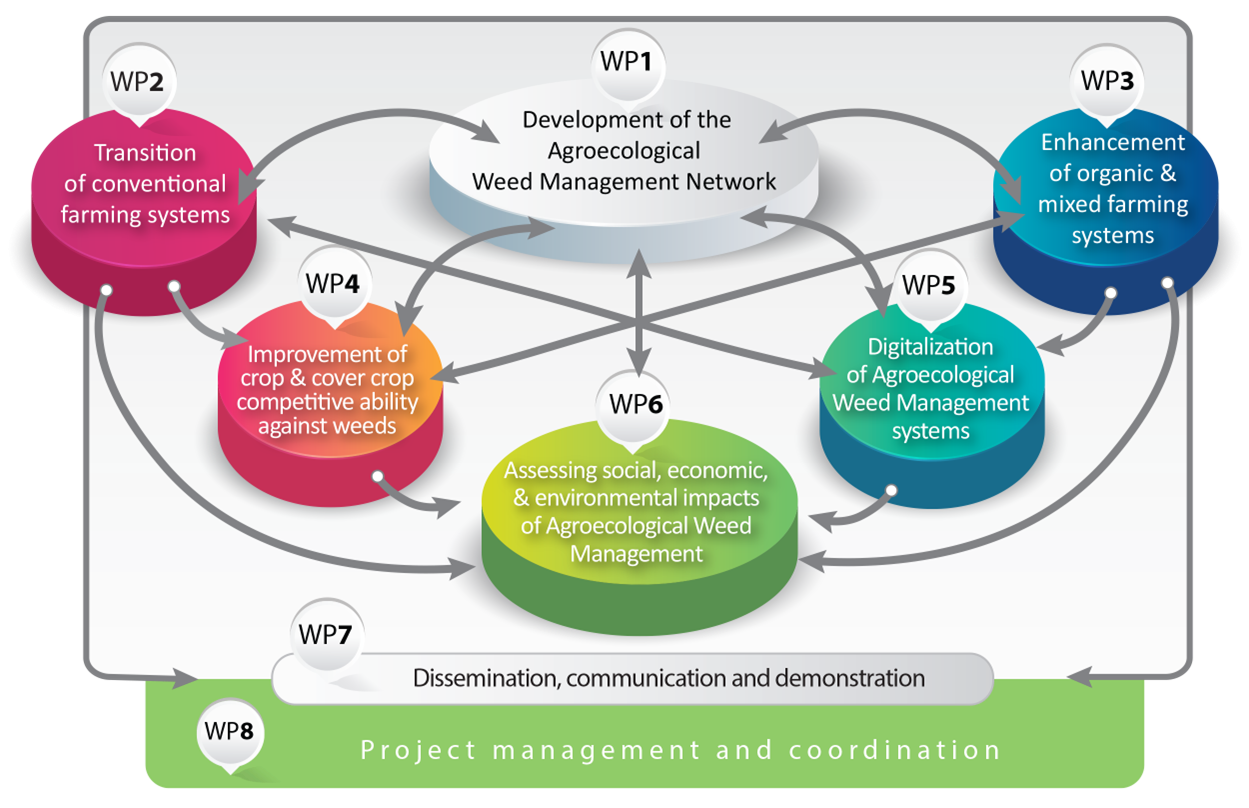
ΠΑΚΕΤΑ ΕΡΓΑΣΙΑΣ ΤΟΥ ΕΡΓΟΥ
WP1
Development of an Agroecological Weed Management Network
(leader: USC)
Objective 1.1
To develop a repository of current weed management practices and use of herbicides in several EU agroecosystems and provide WPs 2-3 with the available and most needed AWM strategies for the selected management scenarios.
Objective 1.2
To develop tools for WPs 2-6 to evaluate the impact of developed AWM strategies and policy support on the end users’ decision-making.
Objective 1.3
To support WPs 6-7 with knowledge and tools for the integration of scientific edge, policy and technology into farming practice.
Objective 1.4
To support WP7 with knowledge of drivers, challenges and opportunities behind the decisions of farmers for a more focused dissemination.
WP2
Transition of conventional farming systems
(leader: AUA)
Objective 2.1
To design and test AWM strategies within LLs, for both annual and perennial crops.
Objective 2.2
To reduce or eliminate herbicide use.
Objective 2.3
To provide standards and typologies for the agroecological transition of conventional farming systems adopted at the national level.
WP3
Enhancement of organic and mixed farming systems
(leader: CICYTEX)
Objective 3.1
To provide standards and typologies for the agroecological promotion in organic and mixed farming systems to be adopted at national level.
Objective 3.2
To develop feasible AWM solutions tailor-made to organic and mixed farmers.
WP4
Improvement of crop and cover crop competitive ability against weeds
(leader: UC)
Objective 4.1
To assess the effect of various AWM strategies on composition, diversity, and abundance of weed communities and the impact on yield components in the previously tested AWM initiatives.
Objective 4.2
To assess weed management issues in the transition phase in relation to soil health.
Objective 4.3
To assess any positive effects (i.e., nitrogen fluxes from legume cover crops) and drawbacks of weed management strategies on soil health and biological fertility.
Objective 4.4
To research and innovate seed inoculation of biostimulant native AMF symbionts, adapted to the different ecosystem characteristics, to guarantee cover crop establishment, edaphic biodiversity enhancement and sustainable weed management.
WP5
Digitalization of Agroecological Weed Management systems
(leader: AUA)
Objective 5.1
To combine AWM solutions with innovative approaches, by integrating image processing and AI pipelines for weed detection activities
Objective 5.2
To test high-end digital solutions (UAVs, robotic mechanical weed control and weed spot spraying) for AWM in various crops and farming systems (arable, perennial), aiming to the adoption and proper use of digital technologies and the chemical weed control reduction.
Objective 5.3
To develop the easy-to-use AWM Toolbox that will determine and provide to all interested parties the appropriate agroecological solution for each case.
WP6
Assessment of social, economic, and environmental impacts of Agroecological Weed Management
(leader: BSB)
Objective 6.1
To predict the medium and long-term impact of the management changes implemented in WP 2-5 on the diversity and abundance of the weed flora and yield loss from weed competition at plot and farm level.
Objective 6.2
To assess the social, economic and environmental impact of AWM, compared to current weed management practices.
Objective 6.3
To identify individual and societal barriers and drivers of AWM adoption to optimize national strategies.
WP7
Dissemination, communication and demonstration
(leader: DELPHY)
Objective 7.1
To ensure that all relevant information from WPs 1-6 is communicated and disseminated to stakeholders in participating countries and engage them in a broad discussion on the state of the art of AWM.
Objective 7.2
To emphasize the creation of communication resources that can be embedded into a web-based platform to ensure durability after the project.
Objective 7.3
To make results of the project known to stakeholders in non-participating EU and Associated Countries.
Objective 7.4
To provide input about AWM for National Action Plans considering main characteristics of member states to be deployed by the policymakers.
WP8
Project management and coordination
(leader: UC)
Objective 8.1
To implement project infrastructure for efficient reporting and internal communication.
Objective 8.2
To organize the kick-off meeting and the international conference.
Objective 8.3
To address financial, ethical, legal, intellectual property and administrative matters related to the consortium and the project, as well as manage gender equality issues, in terms of EU procedures and rules.
GOOD project outcomes
Agroecological Weed Management Network (AWMN)
Digitalization of agroecological weed management
Enhancement of the agricultural systems resilience without jeopardizing productivity and profitability
Development and combination of innovative and socioeconomically validated sustainable agroecological practices that will generate social, economic and environmental benefits through the reduction or elimination of chemical inputs and optimized use of natural resources linked to the post-European Union 2030 targets